What the responses show
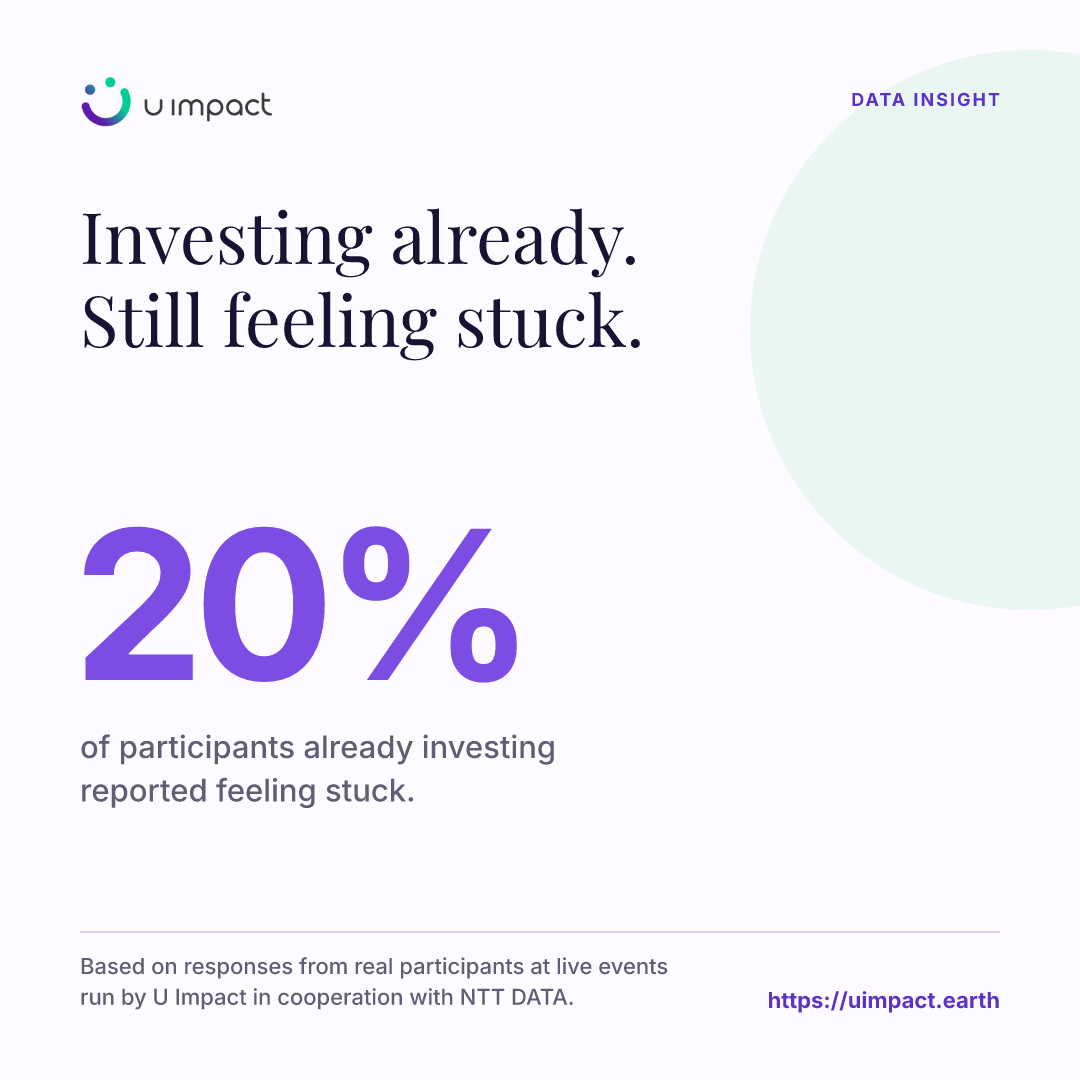
In our verified Mirai event-window reanalysis, 25% of already-investing responses reported feeling stuck.
Based on responses from real participants at live events run by U Impact in cooperation with NTT DATA.
That is a self-reported experience, not evidence that they stopped investing. It raises a useful question for wealth managers: what support do existing investors need when they face their next choice?
The answer might involve explaining options, discussing uncertainty or making the next step clearer. The percentage alone cannot identify the cause.
Look beyond the first completed journey
An existing investor can face a new product, a changed priority or an unfamiliar decision. An account status tells the team that a relationship exists; it cannot describe how each subsequent choice feels. Research should identify the specific decision behind a report of feeling stuck.
For an engagement team, the practical next step is to select a relevant group and explore the support they currently receive. Compare their explanations with the journey and information available to them. A change can then be tested against the intended support outcome rather than assumed to solve a general engagement problem.
Questions for your team
- Which next decision are existing investors facing?
- What support is already available at that point?
- What would distinguish a useful pause from an unresolved obstacle?
Evidence and interpretation
Based on responses from real participants at live events run by U Impact in cooperation with NTT DATA.
The percentage describes participants who selected the already-investing stage and answered the journey-momentum question. Feeling stuck is self-reported; it does not establish inactivity, account abandonment or investment performance.
Aggregate-only reanalysis verified on 10 October 2026: completed response records marked valid, assigned to the Mirai 26 or Mirai 26 Day 2 cohort, and completed on 9-10 June 2026 UTC. Completions outside the event window are excluded. All included stage, momentum and barrier answers were present. The barrier base excludes responses selecting no barrier. The unit is a response record; repeat participation across days has not been ruled out. Current question wording is verified in survey-v2, but historical wording exposure is not independently established. Small subgroup bases require caution. This self-selected, cross-sectional cohort supports neither population estimates nor causal conclusions. The revised cohort replaces the earlier summary percentages, which could not be reproduced with the checked filters.
Read the cohort definitions, methods and revision note.
Read more about our methodology and financial investment behaviour: the field guide.
Put the question to work
U Impact helps investor-engagement teams investigate a defined customer group and develop support options to test. If your onboarding is complete but the next decision is difficult, bring us that journey.